Rwenzori Bugoye
About Rwenzori Bugoye
Bugoye: a decaf from the Mountains of the Moon
Two things usually go missing from a bag of decaf. One is where it came from. The other is any sense that somebody cared how it was made. This one has both, so it's worth taking them in order.
Uganda, and the Arabica nobody expects
Uganda is not the first country most people think of for Arabica. It's known for Robusta, and Robusta is what grows across the central plateau. But the mountain ranges to the east and west are Arabica country, and they have the altitude, the soil and the rainfall to make a serious case for themselves.
Churchill called Uganda the Pearl of Africa, admiring its "magnificent variety of form and colour, profusion of brilliant life and its vast scale." A bi-modal rainfall season keeps the climate pleasant most of the year and the whole place very green.
The Rwenzori
The Rwenzori mountains run for 120 kilometres along Uganda's western border with the Democratic Republic of Congo, and they are properly called the Mountains of the Moon. Peaks over 5,000 metres, snow on top, glaciers feeding the rivers that come down the slopes, one of which is a source of the Nile.
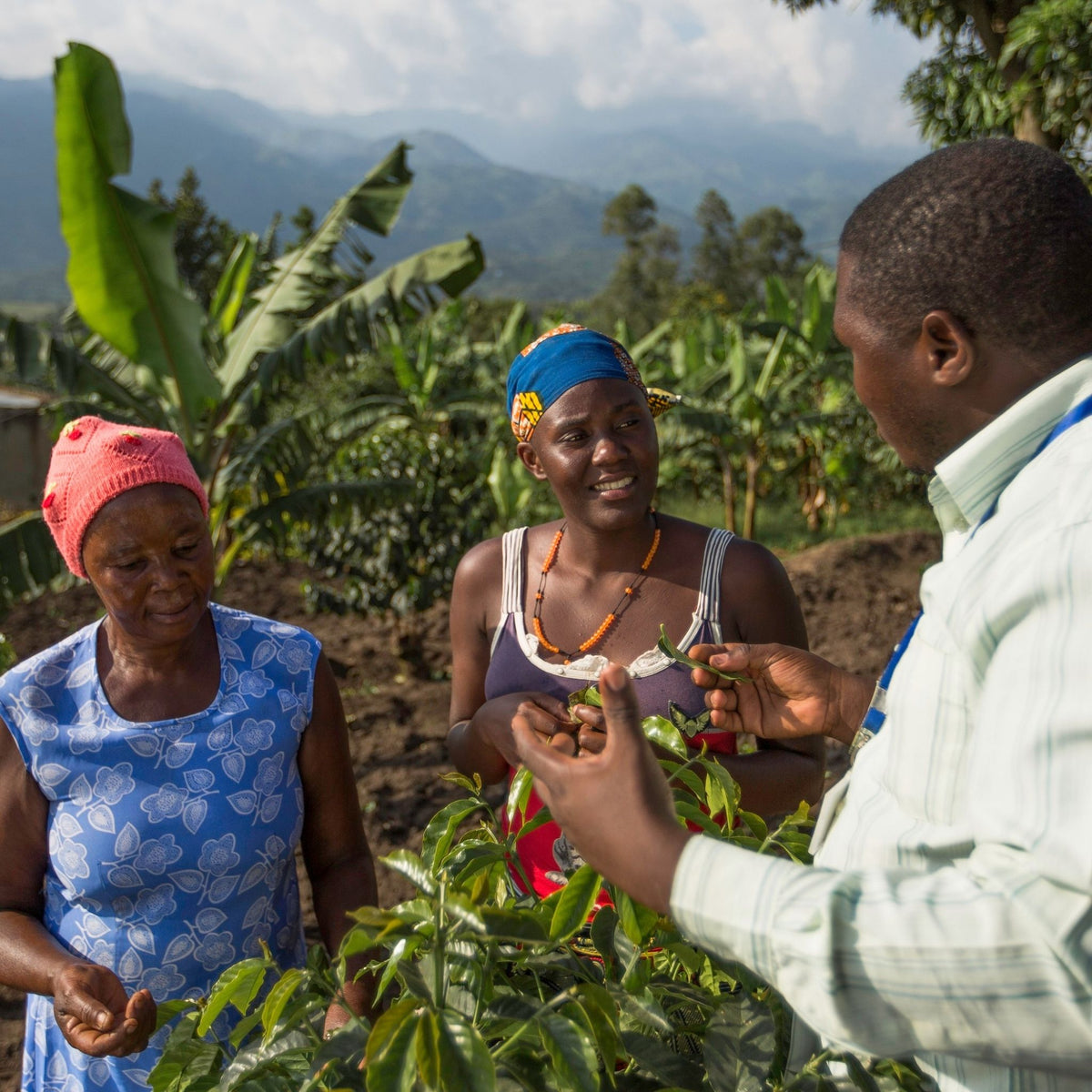
Those slopes are where the Ugandan government is pushing coffee as a driver of rural development, and where the Bakonzo people have been farming the foothills for generations. The coffee grows in the shade of banana trees on mixed farms that also produce cassava, maize, beans and groundnuts, partly to eat and partly to sell.
Bugoye is one of the towns down on the lowlands, connected by road, and it's where Kyagalanyi, the exporting partner here, put their second washing station. Around 2,000 farmers deliver to it, members of the Rwenzori Arabica Scheme, farming more than 1,000 hectares of coffee between them at anywhere from 1,200 to 2,200 metres.
Most of them work about a hectare. All the work is done by hand, usually by the immediate family, and families often team up in community or extended-family groups to process and sell together. Locally that's called share farming, and it makes both quality control and finding a buyer considerably more realistic than going it alone.
What's actually hard about growing coffee here
The document behind this page is unusually blunt about it, so we'll be too.
Farms are small, and yields per tree are low. Three reasons: the trees are old, the soil is short on nutrients, and coffee berry disease and leaf rust both take a bite because resistant varieties aren't widely available in Uganda.
The nutrient problem has a neat arithmetic to it. Soil fertility here is traditionally maintained with agroforestry, cow manure, erosion control and mulching with crop residues. The trouble is that a one-hectare farm supports one to three cows, crop residues often get fed to those cows rather than returned to the soil, and harvest takes more out of the ground each year than any of that puts back. So deficiencies are normal rather than exceptional.
And since almost all the arable land is already being farmed, nobody can solve a low income by planting more. The only direction available is upward, per tree.
What Kyagalanyi does about it
Kyagalanyi runs eight Arabica washing stations in Uganda, all UTZ certified, plus their own dry mill outside Kampala at Namanve, opened in 2015. At Bugoye the offer is processing infrastructure plus agricultural extension work, which in practice means a long list of unglamorous services: group trainings, at least one individual household training per year, demo plots, model farms, coffee nurseries, and free cherry collection.
Two of those are worth pulling out.
Rejuvenation. Regular rejuvenation wasn't really practised in the Rwenzoris. Producers would cut off dead or unproductive stems now and then, which left most trees in the area very old. Kyagalanyi introduced full stumping on the demo plots, so farmers coming back for training watch the rejuvenated trees develop over time and pick up why sucker selection, fertilisation and disease control matter so much afterwards. Then they're encouraged to try it on a few of their own trees.
Coffee Youth Teams. Many farmers in the region are getting older, and taking a hand saw to a mature coffee tree is hard work. So the youth teams exist partly as employment and partly as a service: they'll do your stumping, rejuvenation and input application commercially.
There's also shade tree planting and ecological buffer zones, brought over from Kyagalanyi's work on Mount Elgon, which help regulate temperature and stop sudden downpours washing the topsoil away. Rainfall here is getting less predictable, droughts and violent rainstorms both more frequent, and temperatures are rising. Better farm management is the available answer.
How the coffee gets made
Farmers are encouraged to bring whole cherry to the wet mill rather than pulping it at home, which hands the mill control over the part of the process most likely to go wrong. Since most farmers live up to 50 kilometres away, Kyagalanyi runs a truck that visits every farmer group once or twice a week during harvest, free.
The harvest season runs four to five months, because the trees flower several times, and farmers pick at least once a week.
There's a 95% red cherry policy, checked at every collection point. Bring in cherry that isn't ripe enough and you sort it there and then until it hits 95% before anyone buys it. Tarpaulins and racks are provided for exactly that job.
This lot was processed as a natural. The cherry is floated on delivery, then dried whole on raised beds inside polytunnels. That last detail isn't a preference, it's a necessity: uncovered, the air here is hot enough to crack the parchment, and the rain during harvest makes open drying unreliable anyway. It sits in the tunnels for around 15 days, turned regularly and kept at an even depth, until it reaches the right humidity.
Sugarcane EA decaf, explained properly
This lot was decaffeinated at the Coffein Compagnie in Bremen, using the ethyl acetate process. You'll see it sold as sugarcane decaf or natural decaf.
Ethyl acetate occurs naturally in fruit, which is the reason it's the pick of the natural options. For this process, sugars from sugarcane are fermented into ethyl alcohol, and that gets combined with acetic acid to make ethyl acetate.
Here's the sequence:
- The beans are steamed at low pressure to remove the silver skin.
- They're moistened with hot water so they swell and soften, which sets up the hydrolysis that matters next. Caffeine inside the bean is bonded to chlorogenic acid, and this step is what breaks the two apart.
- The beans pass through an extractor and are washed repeatedly with the ethyl acetate, several times over, until 97% of the caffeine is gone.
- Low-pressure steam passes over the beans to carry off any remaining ethyl acetate. Whatever traces survive that evaporate at 70°C, which is well below roasting temperature.
- The coffee is vacuum-dried back to the moisture level it arrived with, typically 10 to 12%.
Two details people ask about. The beans lose about 3% of their weight over the process. And the whole thing runs without the excessive heat that can damage green coffee, which is the entire argument for doing it this way.
About SL14 and SL28
Scott Laboratories was a research organisation in Kenya that developed a series of cultivars under contract between 1934 and 1963, working from Moka and Bourbon types brought to Kenya by the Scottish and French missions. Worth being precise about the word "developed": these were selected over time, not hybridised. They're old-fashioned selections that happen to have come out of a lab.
SL28 is grown all over East Africa and has a reputation for exceptional cup quality. Wide beans, comparatively low productivity. Various sources claim Scott Labs crossed mutations of French Mission, Mocha and Yemen Typica to get there, though that isn't substantiated as far as we can find. Whatever the genetics, the goal was clearly quality, decent productivity and drought resistance, and it landed the first of those squarely.
SL14 was selected in 1936 from a single tree labelled Drought Resistant II, and drought tolerance is still what it's known for. The records documenting where D.R. II came from were lost, but the seedlings were established at Kabete in 1933 and spread east of the Rift Valley from there. It's now widespread in both Kenya and Uganda.
Most farmers around Bugoye grow old rootstock SL28 and SL34, with the occasional SL14, Nyasaland and Bugisu mixed in. This particular lot is SL14 and SL28.
How Kyagalanyi treats its own people
Worth a paragraph, since it's the part of a supply chain nobody publishes.
Kyagalanyi is ISO accredited and UTZ certified. Wages are set against the role, market rates, cost of living and individual performance. Staff get subsidised lunch, 21 days annual leave, medical insurance or company-funded access to medical facilities, clean drinking water at all sites, and suggestion boxes. The company works to Uganda's Workers Compensation requirements with additional insurance on top, has a compassionate leave policy, and issues PPE appropriate to the job.
The gender engagement programme they run elsewhere on Mount Elgon is planned to extend to the Rwenzori area. They support youth employment through the Coffee Youth Teams, and they promote energy-saving stoves to cut firewood consumption.
Our beans from Rwenzori Bugoye
The best way to learn more about Rwenzori Bugoye? Of course - by trying! Do not miss out, give the beans a try, and let us know your thoughts.