

Fazenda Santa Cruz
About Fazenda Santa Cruz
Fazenda Santa Cruz: 620 hectares outside Varginha, and two people who bought the place in the 2020s
Most farm stories in coffee open with "four generations". This one doesn't. Guilherme and Karyna Rabelo took on Fazenda Santa Cruz in the 2020s, which in farming terms is about five minutes ago, and they've spent the time since being unusually organised about it. That turns out to matter more than heritage does.
Where it is
The farm sits just outside Varginha, in the south of Minas Gerais. Coffee grows here at 980 metres above sea level, on the kind of terrain that has made this corner of Brazil the most productive coffee area on the planet. If you want the full picture of the region, we wrote one.
The farm, and the fifth of it that grows nothing
620 hectares in total. 320 of those are planted with coffee, so slightly over half. A further fifth of the whole farm is kept as preserved native forest, which is a polite way of saying it's land that earns nobody anything, on purpose. On a farm this size that's a real decision rather than a gesture.
Six varieties are in the ground: Arara, Bourbon, Catuaí, Mundo Novo, Acaiá and Icatu. That's a wide spread for one farm, and it's the kind of thing that gives a producer options when a season doesn't behave.
Soil, water, and the parts nobody puts on a bag
Here's where the "unusually organised" bit shows up.
Soil health gets tested on a schedule rather than when something goes wrong. Nutrient levels and pH both, with the results feeding back into how and when the farm feeds its trees. The aim is stated as long-term soil health, which is a slower ambition than a good harvest next year and a considerably more expensive one.
Water is the other half of it. The farm runs efficient irrigation systems alongside a set of water conservation practices, which is what stands between a coffee farm and a bad drought year. Brazil has had a few of those recently. Being ready for the next one is not a marketing line, it's a budget.
Pruning, the least glamorous job on the farm
Coffee trees left to their own devices get tall, tangled and lazy. Fazenda Santa Cruz runs a structured pruning schedule to stop that happening.
Skeleton pruning comes round every four or five years, cutting the tree back to its main framework so it rebuilds itself with fresh productive wood. Stumping goes further, taking a tree right down to start again. Topping keeps height under control, which sounds trivial until you've tried to handpick a four metre tree. And suckering removes the unproductive shoots that would otherwise spend the season drinking the tree's energy and giving nothing back.
None of this makes for good photography. All of it decides what the tree does in year five.
Harvest, and the 24 hours that follow
Cherries are handpicked once they hit peak ripeness, then trucked to the mill on the farm itself. Being able to do that on site is a quiet advantage. Nothing sits on a lorry overnight.
At the mill the cherries are sorted, and anything that isn't at the right stage of ripeness comes out. Within 12 to 24 hours of picking, the cherries go through a machine that strips off the outer fruit skin. Around 5 to 10% of the sticky mucilage is deliberately left clinging to the bean.
That last detail is the whole process in one sentence.
What pulped natural actually does
A washed coffee has all its mucilage scrubbed off before drying. A natural dries inside the whole cherry. Pulped natural sits between the two: skin off, a thin layer of sugar left on.
While the beans dry, that sugar stays in contact with them. As a process, that's what pulped naturals are chosen for, and it's why Brazil built its reputation on this style. It's a fact about the method, not a promise about any one bag, so check the tasting notes on the product page for what this particular lot is doing.
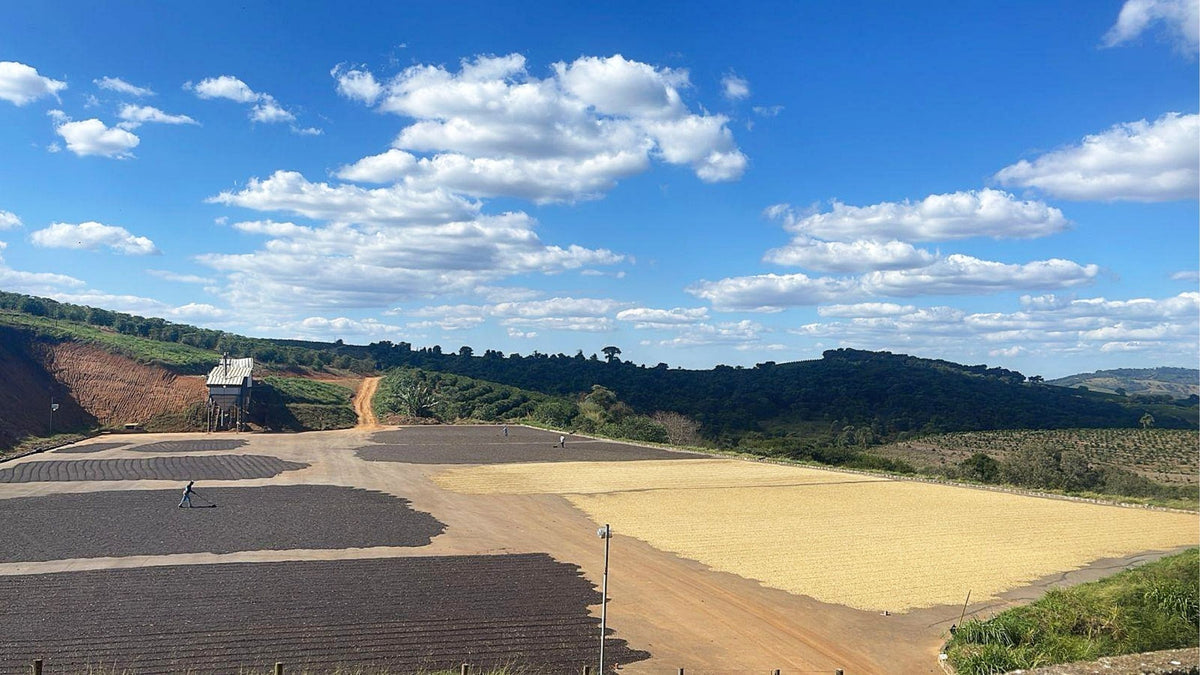
The drying happens on patios, spread in even layers in open sun for 7 to 14 days depending on what the weather is up to. Once the beans hit 10 to 12% moisture they're gathered, bagged and left to rest before being hulled and prepared for export. That resting step is easy to skip and nobody who cares does.
How it reached us
We didn't find this farm on our own. This coffee was sourced with our partner in Brazil, EISA, who have been working with Fazenda Santa Cruz since 2021. Long relationships between an exporter and a farm are one of the more reliable signals in coffee, largely because both sides have to keep showing up.
Our beans from Fazenda Santa Cruz
The best way to learn more about Fazenda Santa Cruz? Of course - by trying! Do not miss out, give the beans a try, and let us know your thoughts.

