Empaako Collective
About Empaako Collective
Empaako Collective: a washing station built the other way round
Empaako means pet name in Rutooro. It's also a company founded in 2025 by Kabuuka Elimethidas, known to everyone as Eli, his wife Immaculate Karungi, and Semilla Coffee, and it exists to fix something specific.
What it's fixing
Here is how coffee normally moves in this part of Western Uganda. A farmer picks cherry and sells it to an intermediary. That intermediary sells it on. By the time it reaches anyone who can actually process it, it has passed through at least three pairs of hands, and the farmer has no idea who ended up with it, what it scored, or what it was worth.
That's not a small inefficiency. It means no feedback, so no way to improve. It means no traceability, so no premium. And it means no investment reaching the farm, so the trees get older and less productive while the person tending them has no resources to do anything about it. Some growers here are working with fewer than 50 trees.
It gets worse. Many producers are locked into arrangements with intermediaries who lend money for school fees or food during the year, and take the harvest at a heavily reduced rate in return. Fertiliser is either unaffordable or simply not in the shops. Tools for pruning, stumping and irrigation, same story. Training barely exists, because there is no directly funded buying structure in the area and the actual processing facilities are a very long way off in Kasese.
Even in 2025, a year of unusually high prices, some farmers in these communities earned around 65 US dollars from coffee. For the year.
Eli
At the start of 2024, Wilts of Semilla was introduced to Eli, a young man who knew the Western Ugandan coffee supply chain from the inside. He was born and raised in the Mubende region and moved close to Fort Portal to work for a green coffee exporter, which is where he learned how the local dynamics really operate.
Then the exporter collapsed and Eli needed new work. What he did next is the reason this page exists: rather than leave the network of farmers he had built over several years with nowhere to sell, he took their harvest himself to the various washing stations over in Kasese.
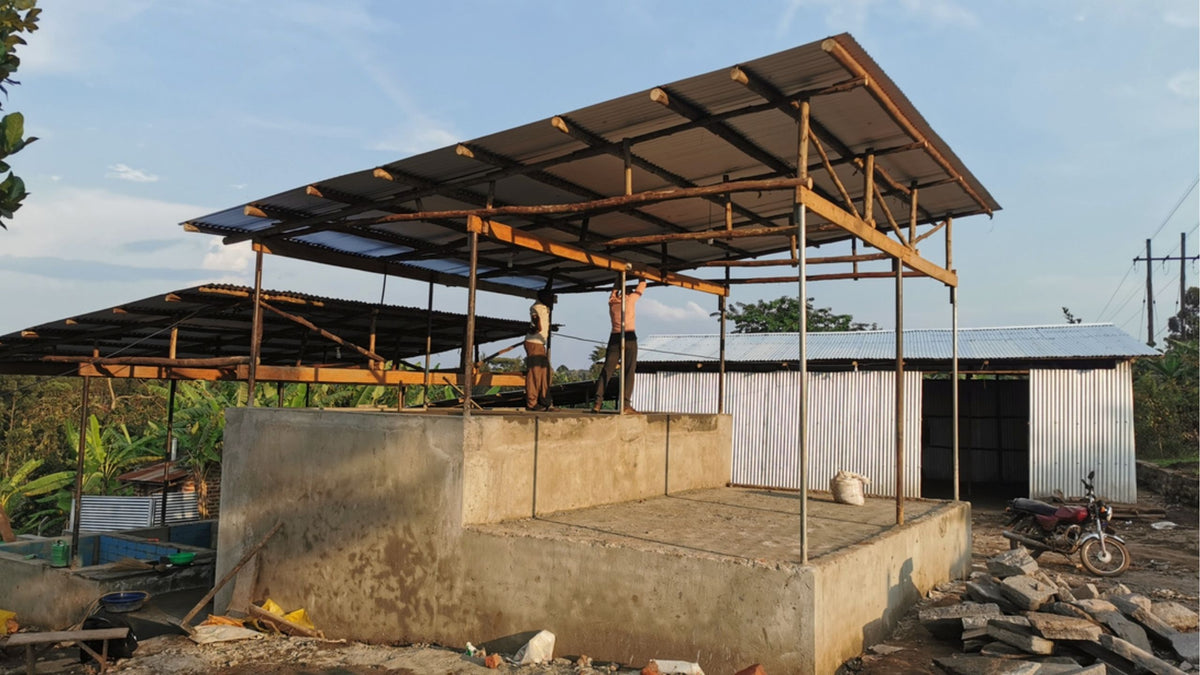
In January 2025, Semilla went back to those communities. By September 2025 they were buying cherry, and the first phase of a small washing station near Fort Portal was up, close to where Eli and Immaculate had settled.
Who runs it
Immaculate Karungi is an agronomist who grew up near Fort Portal and runs all the processing. She and the station team document every processing detail, measure the humidity of the drying parchment and cherry, and track pH during fermentation. Once the dried coffee reaches 10% moisture it's bagged and stored somewhere dry and dark. When she gets a spare moment she's harvesting on her own farm, which is right next to the washing station, and her seed stock feeds the project's nursery, which exists to hand out seedlings to everyone in the collective.
Stanley Masereka is the agronomist in the team and a farmer himself. He organises the daily cherry collections, stays in touch with community members, and visits farms regularly to check for disease and pests, measure how productive the trees are, and give feedback and training on treatment and picking.
Nyakato Viola is the accountant. She leads the daily payments, tracks project spending with Eli, reports on harvested volumes, and handles questions about the payment system.
Around ten more permanent team members make up the rest.
The part that actually changes things
Each community has a representative who collects cherry from their neighbours. In the normal model, that person takes a cut of what they collect. Here they don't. They're a permanent member of the washing station team on proper compensation, which removes the incentive to shave the price of the people around them.
Payment runs through Emata, a Ugandan company that provides micro loans to agricultural producers, using their CRM platform. Every delivery from every producer is logged, and payment goes out in real time as soon as it's registered. Each community representative gets a smartphone to track deliveries themselves, along with the kit to weigh and float cherry, and the company rents them a buying store.
Farmers are paid by Mobile Money, which lets people hold money on their phone without a bank account. MTN's service alone has more than 13 million users in Uganda, and every farmer the collective buys from has an account. Mobile Money charges withdrawal fees if you want your balance as cash, so the collective adds 3% on top of the cherry price to cover them. Small detail, and the difference between a headline price and an actual one.
The cherry price itself is fixed and stable across the season, which is rare here. Local prices swing hard on demand, availability and global trends.
A knock-on effect of logging everything is that the collective holds full harvest data for every individual farmer, and processes each community's coffee separately.
How the coffee is made
Cherry is collected at the buying centre each afternoon, then reweighed, resorted and floated. It ferments for a set time before being depulped over the following days.
For this lot specifically: cherries are picked every three weeks with two weeks of rest in between, then left in a hopper for an initial 16-hour fermentation. After pulping there's a second fermentation in majolica tanks lasting 44 to 48 hours. Then it's washed and dried for 15 to 20 days.
The Kitonya group
This lot comes from the Kitonya and Karangura hills, from a group led by Rosemary Kezabu, a 36-year-old coffee farmer and mother who looks after around 1,600 SL28 trees herself.
Getting coffee to a buyer was the hard part here. Farmers had to move their cherry more than three kilometres, most of them on foot, to sell it in Nyabuswa, the next village of any size. The intermediaries who did come up the hill paid very little for the privilege and often paid late.
Eli's answer was a cherry collection centre in Kitonya itself, run by someone the community already knows and trusts. It saved everyone the walk, and it made the next step of the supply chain visible for the first time. Farmers here previously had no idea which company was buying their coffee, because intermediaries sold to whoever was available and passed back neither quality feedback nor any information about where it went.
After one full season together, the group say they're happy with the quality feedback they're getting, and they're committed to raising their yield per tree. Just after the harvest finished, Eli and the team bought a set of stumping and pruning tools for the group and handed out free seedlings to the growers who started it.
Where Uganda sits right now
In July 2025 Uganda passed Ethiopia to become Africa's largest coffee exporter. Most of that is canephora.
Record volumes have not made the industry diverse. Large multinational traders dominate, vertically integrated with local exporting companies running very big washing stations across the growing regions, and the document behind this page describes their tactics as rigid and repressive.
Specialty has barely featured. Outside several operations around Mount Elgon in the east, most Ugandan coffee regions produce for the commercial trade and nothing else. Farmers in the Rwenzori told Semilla they knew of only two specialty exporters from their area whose coffee shows up in the Global North at all.
Which is a reasonable answer to the question of why you haven't drunk much Ugandan specialty coffee.
Our beans from Empaako Collective
The best way to learn more about Empaako Collective? Of course - by trying! Do not miss out, give the beans a try, and let us know your thoughts.