Lake Kivu coffee: Rwanda's steepest, cleanest cups
Rwanda is nicknamed the land of a thousand hills, which undersells it. Along the western edge, the hills drop from 2,000 metres straight into Lake Kivu, one of Africa's great lakes, and farmers grow coffee on slopes that would make a mountain biker think twice. It is a spectacularly inconvenient place to farm. It also produces some of the cleanest, brightest coffee in Africa.
What the Kivu belt actually is
Lake Kivu is not an administrative region, it is a trade name for the strip of coffee growing land along Rwanda's western border with the Democratic Republic of Congo. Officially you are in the Western Province, and the district names you will see on bags are Karongi, Rutsiro, Nyamasheke, Rubavu and Nyabihu.
Three things make this strip special. The soil is volcanic and genuinely rich. The altitude runs from 1,400 up to about 2,000 metres. And the lake itself acts like a giant radiator, smoothing out temperature swings that would otherwise stress the plants. Put those together and you get slow, even ripening, which is the single best thing that can happen to a coffee cherry.
Almost all of it is Red Bourbon
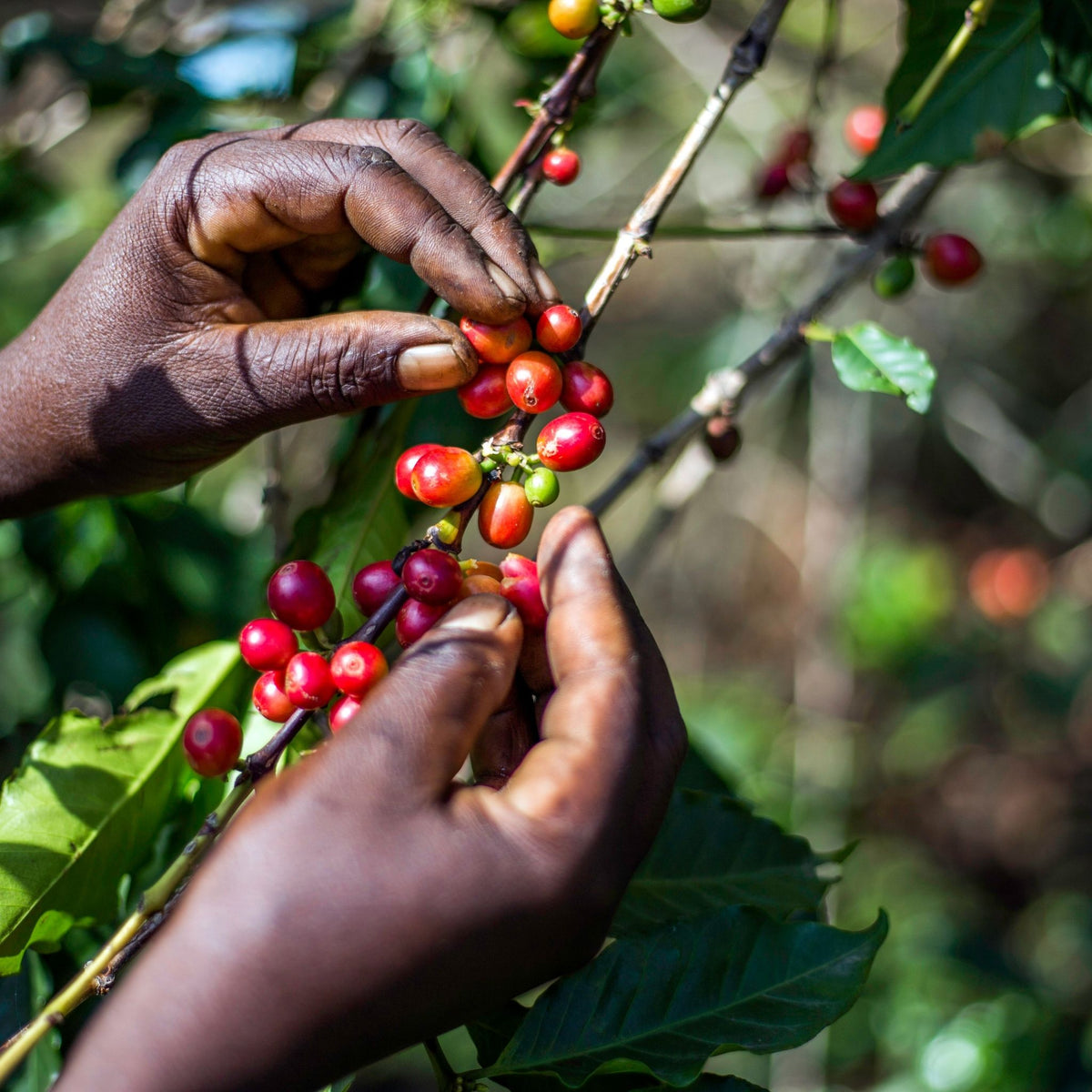
Rwanda made a decision that most origins never did: it stayed loyal to Bourbon. While much of the world planted higher yielding, more disease resistant hybrids, Rwandan farms kept growing Red Bourbon, a variety with modest yields and outstanding cup quality.
Around 400,000 Rwandans grow coffee, and the average plot is under a quarter of a hectare. That's a garden, not a farm. A few hundred trees behind the house, picked by hand, carried down the hill in a bag.
The washing station system
Because nobody has enough trees to process their own coffee, Rwanda runs on coffee washing stations. Farmers deliver ripe cherry, get paid for it, and the station handles the rest: depulping, fermenting, washing, grading and drying. There are hundreds of them across the country and they are the reason Rwandan quality is so consistent.
The technique the country is known for is slow and slightly obsessive. Wet parchment gets hand sorted on the tables, with defective beans picked out one by one before drying even starts. Then the coffee dries in the shade for 15 to 20 days rather than being blasted in the sun, which prevents the tiny cracks that fast drying causes. It is labour intensive and it shows up in the cup as clarity.
A sector rebuilt from almost nothing
Rwandan coffee as you know it today is younger than most people assume. After 1994, the industry was effectively gone. The rebuild started around the turn of the millennium with the first washing stations, and since 2003 the sector has grown by roughly 7 to 8% a year. The shift from bulk commodity to specialty happened deliberately, with government backing, and it worked.
There is one quirk worth knowing about. The potato defect is a rare off-flavour found in coffee from the Great Lakes region, caused by bacteria carried by the antestia bug. One affected bean smells like raw potato peel and can taint a whole brew. It cannot be spotted by machine, so hand sorting really is the only defence. Rwandan producers are more rigorous about sorting than almost anyone, which is part of why they sort so much.
What it tastes like
Rwandan coffee from the Kivu belt tends to be clean and bright without being sharp. Think stone fruit and red berries, orange and plum, a body that reminds people of tea more than syrup, and a finish that often lands on dark chocolate or a spice note. It is elegant coffee. If you like Kenyan intensity but want something gentler, this is your lane.
Brew it as filter and take the water temperature a touch lower than you would for a Brazilian. It rewards patience.